Broken Images and Downloads!

I have had a server issue and lost a whole bunch of images and download files. I am working hard to get them restored, but hang in there while I get it sorted!

Share and Enjoy:
  • Digg
  • del.icio.us
  • StumbleUpon
  • Technorati
  • Facebook
  • Furl
  • Reddit

Introducing Jeep Compass

When Jeep has finally added a compact car-like SUV to its line in May 2006, an obvious question of interest to all its potential buyers arose, as to what is this new little Jeep like.

Chrysler knew full well the need for expansion of its model line and that Jeep would eventually  introduce more car-like models, something that wouldn’t be easy, as the company didn’t want Jeep to lose its go-anywhere off-road reputation. So, Compass is a car that promises its owners the capability to tackle rugged terrain like any other Jeep.

Coming off the assembly line in Belvedere, IL it is sold in the States for MSPR $18,465 – $24,575 with 4 trims available, making it both a good buy and also the first front-wheel drive Jeep with rear drive engaged on-demand, and a fully independent suspension. The transmission lacks the transfer-case with low range gearing needed for serious off-road use, but allows splitting torque in half between rear and front axles for some low traction surfaces.

Jeep Compass is powered by a  2.4 L 172 hp 4-cylinder engine developed in association with Mitsubishi and Hyundai. It is more than adequate for the city use, and even though Compass is fairly heavy for its size it renders estimated 25 mpg in the city and 29 on highways with the standard manual gearbox.  A continuously variable automatic transmission (CVT) that raises cost by $1,000 is also available.

But moving from a more formal presentation to some personal impressions it is worth mentioning that its exterior does create an ambiguous impression. The headlights are round, the front is that of Jeep, but the rear looks like that of a Hyundai. However design is a matter of taste, especially since Chrysler positions Compass as vehicle for young adults. No complaints on the interior, the seats are comfortable, plenty of room for four people and a spacious trunk.

One of the strong points of this car is its handling and steering, which is not any different than that of a sedan. You can negotiate curbs with a speed of 85-100 miles per hour and still be confident. But off the asphalted roads Compass is also capable of performing. Most important part here is to switch off ESP and engage the part-time torque splitter. Here the Jeep’s heritage shines and shows that it is truly capable of much more as opposed to other crossovers.

After all Jeep Compass leaves a very good impression. It is a crossover, but one step above Nissan Xtrail, Hyundai Tucson, Mitsubishi Outlander or Subaru Forester. And even the die-hard fans of Grand Cherokee will enjoy driving it! So welcome Jeep Compass – a good car worth every penny.

Share and Enjoy:
  • Digg
  • del.icio.us
  • StumbleUpon
  • Technorati
  • Facebook
  • Furl
  • Reddit

Statistics – No-one offroads anymore (except Jeep owners!)

The statistics inform that as many as 90 % of the SUV owners don’t ever take their vehicles off-road.

What is this – an excessive concern for a rather expensive investment or just an absence of an actual need to do it? It is a known fact that many people buy SUVs, and in our case various Jeep models, just for the sake of their potential capabilities. The ladies claim that they feel much safer driving a larger vehicle. Men want to know that if all the sudden a snow storm breaks out, they will do fine. So, what if this winter is exactly the chance to turn the usual commuting into a real northern adventure?

And you don’t even have to drive it off the road. The actual road conditions can present a handful of troubles. Intense snow fall, slippery road, reduced visibility, high blizzards… Of course having a Jeep signifies that you are in good shape, but keep in mind that a 4-wheel drive won’t help you stopping any better. There are other things to consider, such as to always slow down when the road is slippery. It’s great to know what kind of 4×4 transmission your Jeep is equipped with. Some models come with a part-time transmission with front axle electronically engaged, when the wheels start to slip, while others have the more serious full-time transmission, and yet the third may look exactly like any other Jeep, but have a modest 2-wheel drive.

And a universal rule that applies is that tires make all the difference. Once could take a modest Subaru Forester, equipped with winter tires, and put it against a full-blown Land Cruiser with summer tires and easily beat it on an icy road. So in stead of putting groundless expectations on your Jeep, change into winter tires ahead of time and give them some time to break in.

And lastly, if you want to please the adventurous spirit in you and take your Jeep off the road, we advise to follow some basic safety rules. Know the terrain you are going to storm. A white layer of snow may insidiously hide trunks of fallen trees, rocks, and other dangerous obstacles. Take with you a shovel and emergency survival gear in case you get stock in a blizzard, as it can take hours to get out. Having a CB radio, traction strips, a tow strap, and a flash light is a must. Remember also to throw in some extra worm clothes and blankets, a buck saw, food and water. But most importantly, tell your close relatives where you are going, and when you are to be expected back. Drive carefully! And now, with all these considerations, your Jeep should be equipped and ready to give you all the pleasures of a winter adventure!

Share and Enjoy:
  • Digg
  • del.icio.us
  • StumbleUpon
  • Technorati
  • Facebook
  • Furl
  • Reddit

So how did Jeep become Jeep?

I think in reality not that many people ever wonder why Jeep is named Jeep. Even less people on the continent of North America know that in many countries of Europe and Asia all SUVs are labeled as “Jeeps”. “He’s got a real nice Jeep now”, one may say pointing at a Land Cruiser.

But how did it come into being that Jeep got its name that now is iconic of this type of all-terrain vehicles? May be the answer to the popularity of the term is that it is the oldest off-road vehicle with Land Rover coming in second. It came into existence as Bantam BRC prototype to become the primary light 4-wheel-drive vehicle used by the US Army and allies for the times of World War II and after that. Following it in its path many nations have since created similar rovers serving both military and civilian roles.

One of the most probable explanations of the origin of the word “Jeep”  is that the soldiers were so impressed with the new go-anywhere rover that they called it Eugene the Jeep, referring to the “jungle pet” character in the Popeye cartoons.  Eugene the Jeep was small and could solve practically any problem.”

Another interesting story is that of a Willys Overland’s test driver Irving “Red” Haussman demonstrating vehicle’s off-road potential by driving it up the steps of the United States Capitol. When asked by reporter Katherine Hillyer, reporter for the Washington Daily News what was the name of it, Irving simply answered, “It’s a Jeep.” Once this phrase made it to Katherine Hillyer’s article with a picture of the vehicle in it, published nation-wide on February 20, 1941, the name stuck to the little 4×4. After being used as a slang word it has finally made it to official use, as in 1950 Willys-Overland Inc. was given the honor of using the name “Jeep” to be their registered trademark.

So now, welcome Jeep, the trusted icon of generations of men who chose to have no boundaries: from Willys-Overland to Jeep Wrangler, from Wagoneer to Grand Cherokee. Jeep – keep the adventure going!

Share and Enjoy:
  • Digg
  • del.icio.us
  • StumbleUpon
  • Technorati
  • Facebook
  • Furl
  • Reddit

Does the Jeep Grand Cherokee Perform offroad?

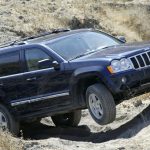
A question that intrigues the minds of people who really like American SUV’s is how well do they perform off the road. Even though 90 percent of the owners will never take them off the road there will always be the other 10% who will take’em to the most unimaginable conditions to test the limits. This following off-road test is aimed at those who wonder how does the Grand Cherokee compares to its rivals. We have chosen the very popular Chevrolet TrailBlazer and the European/Japanese best seller Mitsubishi Pajero to compete with the trusted Cherokee.

TrailBlazer is considerably larger, heavier, and more expensive than the previous Blazer known to all. It does have the strong frame grinder, and struts in stead of torsion bars, which come standard on Chevrolet trucks. In addition it boasts a six-in-line power train with the output of 273 hp. The Grand Cherokee didn’t change so much; it still comes as the most affordable Laredo version, more or less standard Limited, and the luxury Overland. On the civilized asphalt highways Jeep feels as a much more dynamic driver’s car, even though the engine may be producing less power than that of a TrailBlazer. But you have to pay for that by sacrificing some of the comfort; here the TrailBlazer gets its way. And the European and Japanese bestseller 3.8L V6 Mitsubishi Pajero comes equipped with its famous Super Select 4WD transmission, where the driver can use any of four modes: rear-wheel drive, four-wheel drive with limited slipping in center differential, four-wheel drive with locked center differential, and the same mode in low.

Comparing the capabilities of transmissions of the American counterparts we should say that in our opinion the all time 4WD with a locking interaxle differential of Jeep is much more convenient than the front axle engaged when the terrain requires for it that Chevy has. But on the other hand transmission without interaxle differential is much simpler and cheaper, especially taking into consideration that in North America TrailBlazer is also sold in a 2 WD version.

When we got the Chevrolet on the sandy gully in 2WD it quickly bogged down in the sand all the way to  the hubs of the wheels, asking for clicking a switch on the dashboard to engage the front axle and LO mode in the transfer case. With these enabled capabilities it continued to crawl slowly ‘till it came to a point where two of its wheels situated diagonally lost contact with the terrain and hang dangling helplessly in the air. In this case the locking differential of the rear axle doesn’t help, as it is designed with very soft characteristics. This is it, it is time to get the cable out and ask for help.

And what about Mitsubishi? Well, what can we say? Mitsubishi performs more than adequately. The SUV continues to creep steadily forward as long as there is enough traction of the tires. But Jeep with its Quadra-Drive II transmission with two-stage transfer case and three self-locking differentials doesn’t let Pajero beat it. Grand Cherokee gets stuck where Chevrolet gave up, but once you lock the center differential and get it in low it rewards the driver with endless crawling and crawling. Also, Jeep beats Chevy in angles of ascent and descent and higher ground clearance.

To sum it all up, Jeep Grand Cherokee once again proved its nickname of “a tank in a tailcoat”. It held its ground against its rivals. And remember, that hardly a quarter of all the owners of Pajero, Trail Blazer and Grand Cherokee at least once fully utilize the off road capabilities of their vehicles.

Share and Enjoy:
  • Digg
  • del.icio.us
  • StumbleUpon
  • Technorati
  • Facebook
  • Furl
  • Reddit